

Is Oroville Dam Repairs Finished
| Oroville Dam | |
|---|---|
 | |
| Oroville Dam Show map of California Oroville Dam (the United States) Testify map of the U.s. | |
| Country | U.s. |
| Location | Oroville, California |
| Coordinates | 39°32′twenty″N 121°29′08″W / 39.53889°North 121.48556°Westward / 39.53889; -121.48556 Coordinates: 39°32′twenty″N 121°29′08″Westward / 39.53889°North 121.48556°W / 39.53889; -121.48556 [one] |
| Purpose | Water supply, flood command, power |
| Status | Operational |
| Structure began | 1961 |
| Opening date | May 4, 1968 (1968-05-04) |
| Owner(southward) | California Department of Water Resource |
| Dam and spillways | |
| Type of dam | Zoned Earthfill |
| Impounds | Feather River |
| Height (foundation) | 770 ft (235 m)[ii] |
| Length | 6,920 ft (2,109 m)[2] |
| Dam volume | 77,619,000 cu yd (59,344,000 yard3) |
| Spillway type | Service, 8x gate-controlled |
| Spillway capacity | 150,000 cu ft/s (iv,200 10003/due south) (service)[3] |
| Reservoir | |
| Creates | Lake Oroville |
| Total chapters | 3,537,577 acre⋅ft (4.363537 kmthree)[4] |
| Inactive capacity | 29,600 acre⋅ft (0.0365 km3)[5] |
| Catchment surface area | 3,607 sq mi (9,340 kmii)[4] |
| Surface expanse | 15,805 acres (half-dozen,396 ha)[four] |
| Normal pinnacle | 901 ft (275 thousand) (spillway crest)[3] |
| Hydraulic head | 615 ft (187 chiliad)[6] |
| Turbines | 3x conventional 3x pump-generators |
| Installed capacity | 819 MW[six] |
| Capacity cistron | 21% |
| Annual generation | one,629 GWh (2001–2012)[vii] |
| Website water | |


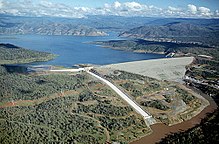
Oroville Dam is an earthfill embankment dam on the Feather River east of the city of Oroville, California, in the Sierra Nevada foothills east of the Sacramento Valley. At 770 feet (235 g) high, it is the tallest dam in the U.S.[eight] and serves mainly for water supply, hydroelectricity generation, and flood control. The dam impounds Lake Oroville, the 2d-largest man-fabricated lake in California, capable of storing more 3.five×10 ^ vi acre⋅ft (one.i×10 ^ 12 US gal; 4.3×10 ^ 12 l).[9]
Built by the California Section of Water Resources, Oroville Dam is one of the key features of the California Land Water Project (SWP), one of two major projects passed that set up California's statewide water system. Construction was initiated in 1961, and despite numerous difficulties encountered during its construction, including multiple floods and a major train wreck on the runway line used to transport materials to the dam site, the embankment was topped out in 1967 and the entire projection was prepare for employ in 1968. The dam began to generate electricity shortly later with completion of the Edward Hyatt Power Plant, then the land's largest hugger-mugger ability station.
Since its completion in 1968, the Oroville Dam has allocated the flow of the Feather River from the Sacramento-San Joaquin Delta into the SWP'due south California Channel, which provides a major supply of h2o for irrigation in the San Joaquin Valley, every bit well as municipal and industrial h2o supplies to littoral Southern California, and has prevented big amounts of overflowing damage to the area—more than than $1.iii billion between 1987 and 1999.[10] The dam stops fish migration up the Feather River and the controlled flow of the river; every bit a result, the Oroville Dam has afflicted riparian habitat. Multiple attempts at trying to counter the dam's impacts on fish migration have included the construction of a salmon/steelhead fish hatchery on the river, which began shortly after the dam was completed.
In February 2022, the principal and emergency spillways threatened to fail, leading to the evacuation of 188,000 people living near the dam.[11] Later on deterioration of the main spillway largely stabilized[12] and the water level of the dam's reservoir dropped below the top of the emergency spillway, the evacuation order was lifted.[13]
The main spillway was reconstructed past November 1, 2022, and water releases were successfully tested, up to 25,000 cu ft/south (710 mthree/s), during Apr 2022.
History [edit]
Planning [edit]
In 1935, work began on the Central Valley Project, a federal water project that would develop the Sacramento and San Joaquin River systems for irrigation of the highly fertile Central Valley. Nonetheless, later the cease of World War II in 1945, the state experienced an economic nail that led to rapid urban and commercial growth in the central and southern portions of the state, and it became clear that California'southward economy could non depend solely on a country water system geared primarily towards agriculture. A new report of California'south water supplies past the Partition of Water Resources (at present California Department of H2o Resources, DWR) was carried out nether an human action of the California State Legislature in 1945.[xiv]
In 1951, California State Engineer A.D. Edmonston proposed the Plumage River Project, the direct predecessor to the SWP, which included a major dam on the Feather River at Oroville, and aqueducts and pumping plants to transfer stored water to destinations in fundamental and southern California. The proposed project was strongly opposed by voters in Northern California and parts of Southern California that received h2o from the Colorado River, but was supported by other Southern Californians and San Joaquin Valley farmers. However, major flooding in the 1950s prompted the 1957 passage of an emergency flood-control bill that provided sufficient funding for construction for a dam at Oroville – regardless of whether it would become part of the SWP.[14] [fifteen]
Construction [edit]
Groundbreaking on the dam site occurred in May 1957 with the relocation of the Western Pacific Railroad tracks that ran through the Feather River Canyon. The Burns-Porter Act of the California Legislature, which authorized the SWP, was non passed until November viii, 1960, and only by a slim margin.[14] [15] Engineer Donald Thayer of the DWR was commissioned to design and head construction of Oroville Dam, and the primary work contract was awarded to Oro Dam Constructors Inc., a joint venture led by Oman Construction Co.[xvi]
Two physical-lined diversion tunnels, each 4,400 ft (1,341 m) long and 35 ft (xi m) in diameter, were excavated to channel the Feather River around the dam site. Ane of the tunnels was located at river level and was to acquit normal water flows, while the second i was merely to be used during floods.[17] In May 1963, workers poured the final of 252,000 cu yd (6.viii million cu ft; 193,000 thouthree) of concrete that comprised the 128 ft (39 m) high cofferdam, to protect the construction site from floods. This construction later served as an impervious cadre for the completed dam. With the cofferdam in identify, an xi-mile (18 km) track line was constructed to movement world and stone to the dam site. An boilerplate of 120 train cars ran along the line each hour, transporting fill up that was mainly excavated from enormous piles of hydraulic mining debris that was done down by the Plume River after the California Gold Blitz.[eighteen]
On December 22, 1964, disaster almost struck when the Feather River, after days of heavy rain, reached a peak flow of 250,000 cu ft/s (vii,100 m3/s) above the Oroville Dam site. The h2o rose behind the partially completed beach dam and nearly overtopped it, while a maximum of 157,000 cu ft/s (4,400 m3/s) poured from the diversion tunnels. This Christmas flood of 1964 was 1 of the virtually disastrous floods on record in Northern California, simply the incomplete dam was able to reduce the peak menstruation of the Plume River by nearly 40%, averting massive damage to the area.[19] [20]
10 months later, four men died in a tragic blow on the construction track line. On October seven, 1965, two xl-car piece of work trains, one fully loaded and the other empty, collided head-on at a tunnel archway, igniting ten,000 United states of america gallons (38,000 l) of diesel fuel, completely destroying 2 locomotives. The burning fuel from the collision started a woods fire that burned 100 acres (40 ha) before it could be extinguished. The crash delayed structure of the dam past a calendar week while the railroad train wreckage was cleared.[21] [22] Overall, 34 men died in the construction of the dam.[22]
Oroville Dam was designed to withstand the strongest possible convulsion for the region, and was fitted with hundreds of instruments that serve to measure water pressure and settlement of the earth fill used in its construction, earning it the nickname "the dam that talks back".[23] (A Thousand50 5.7 earthquake in the Oroville area in 1975 is believed to have been caused by induced seismicity from the weight of the Oroville Dam and reservoir on a local fault line.[24]) The embankment was finally topped out on October 6, 1967, with the final of 155 million tons (140.vi million t) of material that took over 40,000 train trips to ship.[18] On May 4, 1968, Oroville Dam was officially dedicated by the state of California.[25] Among the notable figures present were California governor Ronald Reagan, who spoke,[26] [27] [28] Chief Justice (formerly California governor) Earl Warren, Senator Thomas Kuchel, and California Representative Harold T. "Bizz" Johnson.[29] The dedication was accompanied by a calendar week of festivities in nearby Oroville, attended by nearly fifty,000 people.[30]
2005 dam relicensing [edit]
On October 17, 2005, 3 environmental groups filed a move with the Federal Energy Regulatory Committee (FERC) urging federal officials to require that the dam's emergency spillway exist armored with concrete, rather than remain as an earthen spillway, as it did not meet mod safety standards. "In the event of extreme rain and flooding, fast-rising water would overwhelm the main concrete spillway, then menstruation down the emergency spillway, and that could cause heavy erosion that would create flooding for communities downstream, but also could cause a failure, known equally 'loss of crest command.'" FERC water agencies responsible for the cost of the upgrades said this was unnecessary and that concerns were overblown.[31] [32]
In 2006, a senior civil engineer sent a memorandum to his managers stating, "The emergency spillway meets FERC'south engineering guidelines for an emergency spillway," and "The guidelines specify that during a rare flood consequence, it is adequate for the emergency spillway to sustain significant impairment."[32]
2009 river valve blow [edit]
At around seven:30am on July 22, 2009, several workers were deep below the reservoir operating catamenia controls to test a river valve bedroom in the Oroville Dam. When the flow reached 85%, suction pulled a breakaway wall downstream into a 35-foot (11 m) diversion tunnel, cutting lights and nearly sending three workers to their deaths in the roaring current.
1 of the workers who was badly injured survived by clinging to a bent rail, where he was struck by tools and equipment being sucked into the tunnel. He was hospitalized for four days with head trauma, a broken leg and arm, cuts, and bruises.[33]
Cal OSHA ended opening the valves without an energy-dispersion ring, which reportedly was absent, "created water menstruum with such nifty turbulence that it blocked an air vent and created a vacuum."[34]
The U. Due south. Occupational Safe and Health Administration sanctioned the DWR with half dozen citations, including 5 classified as serious, and the department was initially fined $141,375. Two of the "serious" citations were overturned on appeal.[33] [35]
This river valve organisation was one of the first parts of the dam to be built when the dam project started in 1961, because its initial purpose was to divert the river while the dam was under construction. After that, it served various purposes, including equally a possible emergency release valve.[33] Since the blow, DWR had implemented a standing order that prohibited the operation of the river outlet system and significantly limited access to the river valve chamber.[34] Following the accident, DWR entered into a 2022 understanding with CalOSHA to hire a third-party expert to improve the rubber of the river valve outlet system (RVOS) and make it operational again. In 2022, DWR embarked on an accelerated refurbishment program to reply to concerns about operational needs during the ongoing drought. The system was generally refurbished and was used during 2022 and 2022 to run across Endangered Species Act temperature requirements for the Feather River. Some additional refurbishments were being made to portions of the RVOS and were expected to conclude in early 2022.[36]
2013, 2022 spillway cracks and inspection [edit]
The spillway cracked in 2022. A senior civil engineer with the DWR was interviewed by the Sacramento Bee, and explained, "It'due south mutual for spillways to develop a void because of the drainage systems under them", and "There were some patches needed and then nosotros fabricated repairs and everything checked out."[37]
In July 2022, the state Division of Safety of Dams inspected the dam spillway visually "from some altitude" and did not walk it.[38]
2017 spillway failure [edit]

Oroville Dam spillway impairment, February 27, 2022
Initial spillway damage [edit]
The rainy flavour of 2022–2017 was Northern California'south wettest winter in over 100 years. Heavy rainfall resulted in record inflows from the Plumage River, and the spillway was opened in January to relieve pressure on Oroville Dam. After a second serial of heavy storms in February, the spillway flow was increased to 50,000 cu ft/south (i,400 chiliad3/south), and on February 7, DWR employees noticed an unusual flow pattern. This halted spillway outflow, and DWR brought engineers onto the spillway to audit its integrity. The engineers plant a large area of physical and foundation erosion. This erosion characteristic was as well massive to repair without diverting water to the emergency spillway, and halted outflow forth the main spillway for a period to fix the hole.[39] Loftier inflows to Lake Oroville forced dam operators to continue using the damaged spillway, causing additional harm. The spillway hole continued to grow.[40] Debris from the crater in the principal spillway was carried downstream, and caused damage to the Plumage River Fish Hatchery due to high turbidity.[41]
Although engineers had hoped that using the damaged spillway could drain the lake plenty to avert employ of the emergency spillway,[42] they were forced to reduce its discharge from 65,000 cu ft/due south (1,800 m3/south) to 55,000 cu ft/south (ane,600 m3/s) due to potential harm to nearby ability lines.[43] [44]
Emergency spillway employ and evacuation [edit]

H2o overflowed the parking lot past the emergency spillway (in the background), while water continued to flow through the main spillway (in the foreground), on Feb xi.

Water from the Oroville Dam flows over the emergency spillway on Sunday, February 12
Before long subsequently 8:00 pm on Feb 11, 2022, the emergency spillway began carrying water for the first time since the dam's construction in 1968.[45] The water flowed directly onto the earthen hillside beneath the emergency spillway, as designed. All the same, headward erosion of the emergency spillway threatened to undermine and collapse the concrete weir.
On February 12, an evacuation was ordered for depression-lying areas, due to possible failure of the emergency spillway.[46] The flow over the main spillway was increased to 100,000 cu ft/s (ii,800 mthree/due south) to try to wearisome erosion of the emergency spillway.[47]
By 8:00 pm on the evening of February 12, the increased catamenia had lowered the h2o level, causing the emergency spillway to cease overflowing. On February 14, the sheriff of Butte County lifted the mandatory evacuation order.[13]
Investigation and reconstruction [edit]
On May 19, the spillway was close downwards for the summer, to allow demolition and repair piece of work to brainstorm.[48] The total cost of the repair was projected to exceed $400 million, with the $275 one thousand thousand primary contract awarded to Kiewit Construction.[49] FEMA was expected to cover a large portion of the expenses.[50]
According to an independent forensics team led past John France, the exact crusade of the spillway failure remains uncertain, though they identified "24 possible causes for the spillway failure, including a faulty drainage arrangement, variations in concrete thickness, and corrosion in the construction's rebar."[51]
The government has planned for 2022, to demolish and reconstruct the portion of the spillway which was undamaged by the flood, but which also has been identified as structurally defective. In improver, crews are working to extend a cutoff wall under the emergency spillway to prevent erosion should that structure be used again in the future.[52]
On Nov one, DWR managing director Grant Davis said, "Lake Oroville'due south chief spillway is indeed prepare to safely handle winter flows if needed".[53] While this completes phase one of the structure, there remains a phase 2 to exist completed in 2022. The second phase would include rebuilding the elevation section of the spillway (which was non rebuilt this flavour), putting slabs over the roller compacted concrete section, and constructing a concrete secant cutoff wall for the emergency spillway.[53] The cost estimate at this point is over $500 million.[54] In October 2022, hairline cracks were found in the rebuilt spillway.[55] Things that added to the cost included relocating power lines, dredging the river downstream of the dam, as well every bit the discovery that the bedrock nether the spillway was weak, necessitating deeper excavations and more than concrete.[53]
The DWR deputed an independent board of consultants (BOC) to review and annotate on repairs to Oroville Dam.[56] Memoranda (reports) prepared by the BOC are posted at the DWR web site.[57] The independent forensic team (IFT) has been selected to decide the crusade of the spillways incident, including effects of operations, direction, structural pattern and geological conditions.[58]
| Progression of spillway conditions, Sentinel-two true-colour satellite images |
|---|
|


The Oroville Dam main spillway on August 5, 2022, during phase-2 repairs
According to its 2022–18 operations program, the DWR maintained Lake Oroville at a lower-than-normal level to reduce the possibility that the spillway would have to be used the following wintertime.[59]
In a 2nd phase of spillway repairs in 2022–19, temporary repairs on the chief spillway done during phase one were existence torn out and replaced with steel-reinforced structural concrete.[60]
On April ii, 2022, due to heavy rainfall upstream, the DWR began releasing water over the newly reconstructed spillway at a rate of 8,300 cfs.[61] Releases were increased to 25,000 cfs on April 7 to exam how the spillway performed in college flows. They were decreased to 15,000 cfs on Apr 9.
2020–21 Drought [edit]

Edward Hyatt Powerplant at Oroville Dam on August 15, 2022: In early on Baronial 2022, the hydroelectric power constitute has been shut down due to low h2o levels in Lake Oroville caused by the drought in California.
Due to the low atmospheric precipitation in the catchment surface area, h2o levels were below normal beginning in 2022. In Baronial 2022, the Hyatt power plant had to be shut downwards because the water level fell below its water inlets.[62] After falling to a tape low of 22% capacity past September 30, winter storms increased the lake level past December and the plant was restarted on January 4, 2022.[63]
Operations [edit]
Hydroelectricity [edit]

Satellite view showing Lake Oroville (right), Oroville Dam (lesser center), and Thermalito Forebay (bottom left)
Structure of the underground Edward Hyatt Pump-Generating Plant was finished shortly after the completion of Oroville Dam. At the time, it was the largest underground power station in the United States,[eighteen] with three 132-megawatt (MW) conventional turbines and three 141 MW pump-generators for a total installed capacity of 819 MW.[vi] The Hyatt Powerplant is capable of pumping water dorsum into Lake Oroville when surplus ability is bachelor. The pump-generators at Hyatt can elevator upwardly to v,610 cubic feet per 2nd (159 k3/s) into Lake Oroville (with a net consumption of 519 MW), while the six turbines combined apply a menstruation of 16,950 cu ft/due south (480 m3/due south) at maximum generation.[64]
Since 1969, the Hyatt plant has worked in tandem with an all-encompassing pumped-storage operation comprising ii offstream reservoirs west of Oroville. These two facilities are collectively known equally the Oroville–Thermalito Complex.[65] Water is diverted into the upper Thermalito reservoir (Thermalito Forebay) via the Thermalito Diversion Dam on the Feather River. During periods of off-top ability employ, surplus energy generated at Hyatt is used to lift h2o from Thermalito's lower reservoir (the Thermalito Afterbay) to the forebay, which releases water back into the afterbay to generate up to 114 MW of power at times of high need.[66] The Hyatt and Thermalito plants produce an boilerplate of 2,200 gigawatt hours (GWh) of electricity each year, almost one-half of the total power produced past the SWP's eight hydroelectric facilities.[67] [68]
Water supply [edit]
Water released from Oroville Dam travels downwards the Feather River earlier joining with the Sacramento River, eventually reaching the Sacramento-San Joaquin Delta, where the SWP'due south California Aqueduct diverts the fresh water for transport to the barren San Joaquin Valley and Southern California. Oroville–Thermalito hydroelectric facilities furnish about one-tertiary of the ability necessary to drive the pumps that lift the h2o in the aqueduct from the delta into the valley, then from the valley over the Tehachapi Mountains into coastal Southern California.[68] [69] Water and power from the dam contribute to the irrigation of 755,000 acres (306,000 ha) in the arid San Joaquin Valley Westside and municipal supplies to some 25 one thousand thousand people.[70] At least two.viii million acre⋅ft (910 billion Us gal; 3.5 trillion l) of h2o is released.[71]
Alluvion control [edit]

Partial view of the dam's emergency spillway (left) next to its primary service spillway (far right) (2008)
During the winter and early spring, Lake Oroville is required to accept at least 750,000 acre⋅ft (240 billion US gal; 930 billion fifty), or a fifth of the reservoir's storage capacity, available for flood control.[72] The dam is operated to maintain an objective overflowing-control release of 150,000 cubic feet per second (4,200 mthree/south), which may be further reduced during big storms when flows below the Feather'due south confluence with the Yuba River exceed 300,000 cubic feet per second (8,500 10003/s).[73] In the particularly devastating flood of 1997, inflows to the reservoir hitting more than 331,000 cubic feet per 2d (nine,400 m3/s), but dam operators managed to limit the outflow to 160,000 cubic anxiety per second (four,500 mthree/s), sparing large regions of the Sacramento Valley from flooding.[74] [75]
Plumage River Fish Hatchery [edit]
Oroville Dam completely blocks the anadromous migrations of Chinook salmon and steelhead trout in the Feather River. In 1967, in an effort to recoup for lost habitat, the DWR and the California Section of Fish and Game completed the Feather River Fish Hatchery.[76] The Fish Barrier Dam, built in 1962, intercepts salmon and trout earlier they reach the base of the impassable Thermalito Diversion Dam and forces them to swim upward a fish ladder to the hatchery, which is located on the north banking company of the Plume River. The hatchery produces 10 million salmon smolt, forth with 450,000 trout smolt, to stock in the river each year.[77] The salmon smolt are released in two runs, with 20% for the spring run and fourscore% for the fall run. This facility has been successful plenty that concern exists that salmon of hatchery stock are outcompeting remaining wild salmon in the Feather River organization.[78] [79]
Cultural references [edit]
In the 2022 speculative fiction thriller Rising of the Water Margin, the Oroville Dam is the target of an eco-terrorist attack utilizing software to activate and conciliate the reverse pumping of the turbines resulting in resonance that shakes the dam autonomously.
See also [edit]
- New Bullards Bar Dam
- List of hydroelectric ability station failures
- List of dams and reservoirs in California
- List of lakes in California
- Listing of largest reservoirs of California
- Listing of power stations in California
- Listing of tallest dams in the United States
- New Bidwell Bar Span
References [edit]
- ^ "Lake Oroville". Geographic Names Data Arrangement. United States Geological Survey. Jan 19, 1981. Retrieved March 31, 2022.
- ^ a b "Oroville Dam". National Performance of Dams Programme. Stanford Academy. Retrieved March 31, 2022. [ permanent dead link ]
- ^ a b "Oroville Facilities (FERC Project No. 2100)" (PDF). California Department of Water Resources. Jan 2005. Archived from the original (PDF) on May 25, 2022. Retrieved Feb 13, 2022.
- ^ a b c "Oroville Dam (ORO)". California Data Exchange Center. California Section of H2o Resources. Retrieved March 31, 2022.
- ^ Ritzema, Randall S.; Newlin, Brad D.; Van Lienden, Brian J. (October 2001). "Appendix H: Infrastructure" (PDF). CALVIN Projection. University of California Davis. Retrieved Jan 25, 2022.
- ^ a b c "Edward Hyatt Powerplant". California State Water Project. California Section of Water Resources. June 17, 2009. Archived from the original on Apr 7, 2022. Retrieved April 2, 2022.
- ^ "California Hydroelectric Statistics & Information". California Free energy Commission. Retrieved April 26, 2022.
- ^ "Dam, Hydropower and Reservoir Statistics". United States Society on Dams. Archived from the original on March 25, 2022. Retrieved March 31, 2022.
- ^ "Alphabetical List of California Dams (Over xl,000 acre feet)". Civil and Environmental Engineering. University of California Davis. Archived from the original on Feb v, 2022. Retrieved March 31, 2022.
- ^ "The Benefits of Dams to Society". USCOLD Newsletter. United States Society on Dams. March 1999. Archived from the original on October i, 2022. Retrieved September 4, 2022.
- ^ 188,000 under evacuation orders virtually Northern California dam Archived February 23, 2022, at the Wayback Machine
- ^ "Updates: New storms approach, but officials confident Oroville Dam and spillways will hold up". Orlande Sentinel . Retrieved February 23, 2022.
- ^ a b Daniels, Jeff (February 14, 2022). "Government lift mandatory evacuation orders for Oroville Dam emergency". CNBC. Retrieved February 14, 2022.
- ^ a b c "History of H2o Development and the Country Water Projection". California Department of Water Resources. October 8, 2008. Archived from the original on Baronial 23, 2010. Retrieved April two, 2022.
- ^ a b Keats, Adam (Oct 2007). "2. Country Water Projection" (PDF). Water Wars: Present and Time to come. Planning and Conservation League. Archived from the original (PDF) on May 15, 2022. Retrieved April 2, 2022.
- ^ "Exhibit C: Construction History and Proposed Construction Schedule" (PDF). Oroville Facilities FERC Project No. 2100. California Department of Water Resources. Jan 2005. Retrieved Apr 4, 2022.
- ^ "History". Oroville – The Forgotten Aureate City. Oracle ThinkQuest Education Foundation. Archived from the original on May 16, 2022. Retrieved April 2, 2022.
- ^ a b c Hoffer, William (July 1985). "Taming the Plumage River: The Plumage River took one life likewise many. So they built the Oroville Dam. It's a civil engineering landmark today". Popular Mechanics. 162 (7): 78–80.
- ^ "Flood! December 1964 – January 1965". California Department of Water Resources Message No. 161. Net Annal. 1965. Retrieved April 2, 2022.
- ^ "California Inundation Command Programme, 1965". California Section of Water Resources Message No. 159-65. Internet Archive. 1965. Retrieved April 2, 2022.
- ^ "Bodies of Railroad train Crash Victims Are Recovered". Lodi News-Sentinel. Associated Press. October 9, 1965.
- ^ a b Larry Matthews. "THE OROVILLE DAM Railroad train TUNNEL COLLISION".
- ^ Griswold, Wesley S. (February 1967). "The Dam That Talks Dorsum: Earth's highest earth dam will continue an centre on itself to written report every stress and strain". Pop Science. 190 (2): 86–87.
- ^ Allen, Clarence R. (November 1982). "Reservoir-Induced Earthquakes and Engineering Policy". California Geology. 35 (11). Archived from the original on June 24, 2022. Retrieved Apr iii, 2022.
- ^ View Ch.5 KPIX-Television set newsfilm coverage from the dedication anniversary for Oroville Dam, shot on May 4th 1968: https://diva.sfsu.edu/collections/sfbatv/bundles/231000
- ^ "Ronald Reagan Presidential Library – National Athenaeum and Records Administration – Ronald Reagan Presidential Library – National Athenaeum and Records Administration". reaganlibrary.gov. Archived from the original on February thirteen, 2022. Retrieved February 13, 2022.
- ^ "Larry Matthews – Nancy Reagan dies at historic period 94. She and and then... | Facebook". world wide web.facebook.com . Retrieved Feb 13, 2022.
- ^ "Oroville dam in crisis raises alarm in California". MSNBC . Retrieved February thirteen, 2022.
- ^ "Massive Dam At Oroville Is Defended". Merced Dominicus-Star. Associated Press. May four, 1968.
- ^ "Oroville Dam Dedication Today". The Press-Courier. Associated Press. May 4, 1968.
- ^ "State was warned most inadequacy of emergency spillway". Feb thirteen, 2022. Retrieved February 13, 2022.
- ^ a b "Oroville Dam: Feds and state officials ignored warnings 12 years ago". San Jose Mercury News. February 13, 2022. Retrieved February xiii, 2022.
- ^ a b c Sarah Moore (February 17, 2022). "River valve damaged in 2009 could take been third way to release backlog water". KXTV. Archived from the original on January 2, 2022.
- ^ a b Barbara Arrigoni (September 12, 2022). "DWR planning study on worrisome river valves blamed in 2009 Oroville Dam accident". Oroville Mercury-Annals.
- ^ "Inspection Particular". Occupational Rubber and Health Administration.
- ^ "Draft 2022 Annual Review of the construction and operation of the State H2o Project" (PDF). California Water Commission. pp. 4, 5.
- ^ Bollea, Drew (February 10, 2022). "Maintenance Records Evidence Oroville Dam Spillway Previously Patched". cbslocal.com. CBS. Retrieved February 13, 2022.
- ^ Arthur, Damon. "Dam spillway checked from 'distance' in concluding inspection". redding.com. Tape Searchlight. Retrieved Feb 13, 2022.
- ^ "Oroville Spillways Incident Background". State of California. Retrieved April 4, 2022.
- ^ Graff, Amy (Feb 10, 2022). "Gaping hole in Oroville Dam spillway is growing, officials warn". SFGate . Retrieved February ten, 2022.
- ^ "Fish evacuated from Feather River Hatchery". KRCR. February eleven, 2022. Archived from the original on Nov 16, 2022. Retrieved February 13, 2022.
- ^ "Sacrificing California spillway may avoid emergency releases". Retrieved February 11, 2022.
- ^ "Apply of untested emergency spillway yet again a possibility at bedridden Oroville Dam". Sacramento Bee . Retrieved Feb 12, 2022.
- ^ CA DWR (Feb 10, 2022). "Lake Oroville Releases Slowed to Avoid Erosion" (PDF). Archived from the original (PDF) on February xiii, 2022. Retrieved Feb 12, 2022.
- ^ "The Latest: Emergency Spillway Use Likely at Oroville Dam". ABC News. Associated Press. February 10, 2022. Archived from the original on February 10, 2022. Retrieved Feb ten, 2022.
- ^ KCRA Staff (February 13, 2022). "Thousands from Yuba, Butte, Sutter counties evacuated". KCRA . Retrieved February xiii, 2022.
- ^ "BREAKING: Fearing collapse of emergency spillway at Oroville Dam, Oroville evacuated". Sacramento Bee. February 12, 2022. Retrieved Feb 12, 2022.
- ^ Fimrite, Peter (May xviii, 2022). "Oroville Dam spillway to go offline until fall, allowing for repairs". SFGate . Retrieved June 10, 2022.
- ^ Grossman, David (June six, 2022). "The Oroville Dam Disaster Will Terminate Up Costing About $400 Meg". Pop Mechanics . Retrieved June 10, 2022.
- ^ Kasler, Dale (June 4, 2022). "'A once in a lifetime opportunity.' Who made money off the Oroville Dam crisis?". Sacramento Bee . Retrieved June ten, 2022.
- ^ Kasler, Dale (June 1, 2022). "Oroville Dam update: Fracture likely caused by 'multiple factors'". Sacramento Bee . Retrieved June x, 2022.
- ^ Johnson, Risa (September xviii, 2022). "Oroville Dam: What exactly volition be washed past Nov. one?". Mercury News . Retrieved September 25, 2022.
- ^ a b c Dale Kasler (November 1, 2022). "Oroville Dam fix to withstand winter rains as first phase of repairs is finished, officials say". Sacramento Bee . Retrieved Nov 1, 2022.
- ^ KCRA Staff (November one, 2022). "'Milestone' reached in Oroville spillway construction". Retrieved November i, 2022.
- ^ "Big California Dam'south New Spillway Already Has Cracks in It". U.S. News and World Written report. Associated Press. November 28, 2022. Retrieved January 1, 2022.
Serna, Joseph (December 2, 2022). "Costs soar and cracks revealed in Oroville Dam spillway, but officials say it's prepare for winter rains". Los Angeles Times . Retrieved January 1, 2022. - ^ California Department of Water Resources (November 20, 2022). "Oroville Spillways Incident, Lath of Consultants". Archived from the original on January xxx, 2022. Retrieved January 29, 2022.
- ^ Board of Consultants (December twenty, 2022). "Reports from the Lake Oroville Spillways Recovery Projection, Board of Consultants". Archived from the original on January 30, 2022. Retrieved January 29, 2022.
- ^ Contained Forensic Team (2017). "Preliminary and acting reports of the Lake Oroville Spillways Recovery Project, Independent Forensic Squad". Archived from the original on January 31, 2022. Retrieved Jan 30, 2022.
- ^ DWR (October 16, 2022). "Lake Oroville 2022/2018 Flood Control Season Operations Plan" (PDF) . Retrieved January 30, 2022.
- ^ Harvey, Chuck. "Kiewit Leads Phase Two of Oroville Dam Spillway Repairs". ConstructionEquipmentGuide.com . Retrieved August 7, 2022.
- ^ "DWR Uses Oroville Chief Spillway". water.ca.gov . Retrieved April three, 2022.
- ^ "California Shuts Down Major Hydroelectric Plant Due To Low Water Levels At Lake Oroville".
- ^ "Lake Oroville rises 89 feet, power plant resumes operation after December rains".
- ^ "Section 2: Proposed Action and Alternatives". Federal Energy Regulatory Commission Concluding Environmental Impact Argument for the Oroville Facilities Project. Butte County, California. pp. 13–42. Retrieved Apr 2, 2022.
- ^ "Oroville Reservoir and Thermalito Facilities". Northern California Water Association. Retrieved April 2, 2022.
- ^ Zmuda, Joseph (September 1972). "Slaking California'south mammoth thirst with the Globe'southward Largest Water: Surplus water from the northward now flows to arid regions via this gigantic $2.iii billion projection". Pop Science. 201 (three): 62–64.
- ^ "Chapter 7: Power Product and Free energy Consumption" (PDF). Proposed Lower Yuba River Accord. Yuba River Direction Team. June 2007. Retrieved Apr 2, 2022.
- ^ a b "Benefits Of The California Country Water Project". California Section of Water Resources. July 18, 2008. Archived from the original on April 4, 2022. Retrieved April 2, 2022.
- ^ "Ability Resources". Bulletin 132–95. California Department of Water Resources. Archived from the original on April 5, 2022. Retrieved Apr two, 2022.
- ^ "California State Water Project Overview". California Department of Water Resource. August 11, 2010. Retrieved April 2, 2022.
- ^ doe, john. "Oroville Dam". watershed.ucdavis.edu . Retrieved Apr thirty, 2022.
- ^ "Oroville Facilities". California State Water Project. California Department of Water Resources. June 17, 2009. Retrieved April 2, 2022.
- ^ "Chapter 6: Assessment of Current Alluvion Management Systems" (PDF). U.South. Army Corps of Engineers, Sacramento Commune: Post-Inundation Cess for 1983, 1986, 1995 and 1997. Auburn Dam Council. Archived from the original (PDF) on July 25, 2022. Retrieved April ii, 2022.
- ^ Roos, Maurice (1997). "The Bully New year's day'south Overflowing of 1997" (PDF). California Extreme Precipitation Symposium. Retrieved April 2, 2022.
- ^ "Oroville Dam (ORO) Information Query (REL SCH) for 01/01/1997 through 01/02/1997". California Data Exchange Center. California Section of Water Resources. Retrieved August 10, 2022.
- ^ "Feather River Fish Hatchery". California Department of Fish and Wildlife. Retrieved Feb 12, 2022.
- ^ "California Hatchery Review Report" (PDF). California Hatchery Scientific Review Grouping. June 2022. Retrieved February 12, 2022.
- ^ "Mariculture: Chinook Salmon and Steelhead Trout". MarineBio.net Marine Science. 2003. Retrieved April 2, 2022.
- ^ Weston, Mary (October 8, 2010). "Salmon spawning under mode at Feather River hatchery". ChicoER. Archived from the original on Jan 19, 2022. Retrieved Apr 2, 2022.
External links [edit]
- Current Conditions, Oroville Reservoir, California Department of Water Resource
- Oroville Spillways Incident, California Section of Water Resources
- Official website California Department of Water Resources, Oroville Dam
- Oroville Facilities, FERC Project #2100
- Oroville Facilities Relicensing
- Hillhouse, Grady. "What Really Happened at the Oroville Dam Spillway?". Practical Applied science (Video). Archived from the original on Dec 12, 2022 – via You Tube.
- "Lake Oroville Runoff Enhancement Project" Terminal Written report submitted to California Dept of Water Resource Partitioning of Operations and Maintenance (Sept 1995); published by Usa Department of the Interior's Bureau of Reclamation Technical Service Eye (River Systems and Meteorology Group).
-
- Abstruse: "Bureau of Reclamation cooperated with California Section of Water Resources to blueprint and implement a snowpack augmentation programme to increase runoff to Oroville Reservoir. The plan involves collection of information to document physical processes leading to increased precipitation. This report summarizes main results from iii twelvemonth of in-situ physical studies and statistical analysis of precipitation data nerveless during 87 randomized seeding cases. Liquid propane released from high top sites has proven to be a viable, reliable method of seeding wintertime clouds in the Sierra Nevada."

Is Oroville Dam Repairs Finished,
Source: https://en.wikipedia.org/wiki/Oroville_Dam
Posted by: kelleyolleefors.blogspot.com
0 Response to "Is Oroville Dam Repairs Finished"
Post a Comment